Women's Wellness
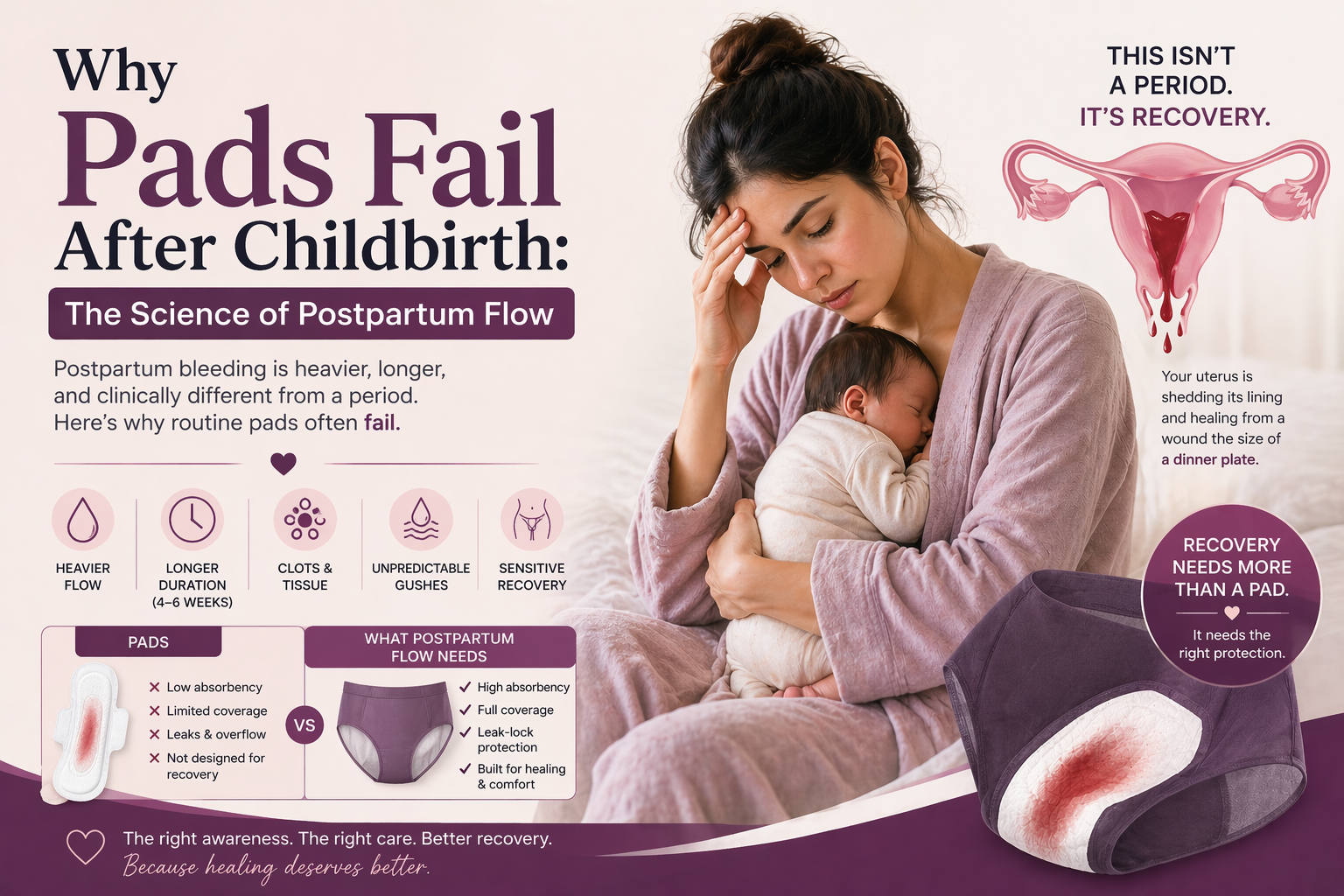
Why Pads Fail After Childbirth: The Science of Postpartum Flow
Postpartum bleeding is not designed for period products. Understand the clinical differences in flow, volume, and duration, and why pads often fail during recovery.
Not all bleeding is managed the same way
After childbirth, the body enters a recovery phase.
The uterus sheds tissue, blood, and mucus as it heals. This discharge-lochia, is not comparable to a menstrual cycle.
It is heavier. Less predictable. And clinically different.
Yet most women are given the same solution: a sanitary pad.
The Core Problem: Pads Are Built for Periods
Sanitary pads are engineered for cyclical, hormone-driven bleeding.
Postpartum flow is wound-driven.
That difference changes everything:
Flow intensity
Fluid composition
Duration
Absorption demand
Pads are not designed for this level of variation.
1. Volume Overload: When Absorbency Breaks Down
In the first few days after delivery, bleeding can be significantly heavier than a period.
Pads often fail because:
They reach saturation quickly
Fluid spreads instead of locking in
Sudden gushes cannot be contained
This leads to frequent changes, leakage, and discomfort.
2. Gush Flow vs Gradual Absorption
Menstrual flow is relatively steady.
Postpartum flow is not.
It often comes in unexpected surges, especially:
When standing up
After feeding
After resting for long periods
Pads are designed for gradual absorption—not sudden release.
This mismatch causes leakage even when the pad is not fully saturated.
3. Clots and Tissue: A Structural Mismatch
Postpartum discharge is not just liquid blood.
It includes:
Blood clots
Tissue fragments
Mucus
Pads are not built to handle variable density flow.
Clots can:
Block absorption channels
Sit on the surface
Increase the risk of overflow
4. Duration Mismatch: Days vs Weeks
A typical period lasts 4–6 days.
Postpartum bleeding can last 4–6 weeks or longer.
This creates a different requirement:
Sustained hygiene
Consistent protection
Skin-safe prolonged use
Pads are not designed for continuous, long-term wear cycles at this intensity.
5. Coverage Gaps: Where Leakage Actually Happens
Postpartum bleeding does not follow a fixed pattern.
Leakage often occurs:
At the back while lying down
At the sides during movement
During sleep when flow direction changes
Pads provide limited surface coverage.
They rely on correct placement, which is difficult with unpredictable flow.
6. Skin Stress During Recovery
After childbirth, the body is healing:
Perineal tears
Surgical incisions (C-section)
Swelling and sensitivity
Pads can contribute to:
Friction
Moisture retention
Skin irritation
Recovery requires soft, breathable, low-friction materials.
What Postpartum Flow Actually Demands
Postpartum care should match the physiology of recovery.
The requirements are clear:
High-capacity absorption for heavy flow
Ability to handle sudden gushes
Surface structure that manages clots
Full front-to-back coverage
Breathable, skin-safe materials
Stability during movement and sleep
This is not a feature upgrade.
It is a different product category requirement.
Why This Gap Exists
The market has historically treated all bleeding as the same.
It is not.
Menstrual care products were never designed for:
Surgical recovery
Internal wound healing
Extended high-volume discharge
This is why failure is common, and expected.
Final Note
When a product fails repeatedly, the issue is not usage.
It is design.
Postpartum bleeding is not a period.
It is recovery.
And recovery needs to be supported accordingly.