Women's Wellness
How Long Does Postpartum Bleeding (Lochia) Last? A Week-by-Week Guide
Most new moms aren't told that postpartum bleeding can last 4–6 weeks. Here's exactly what to expect stage by stage — and the warning signs that need a doctor's attention.
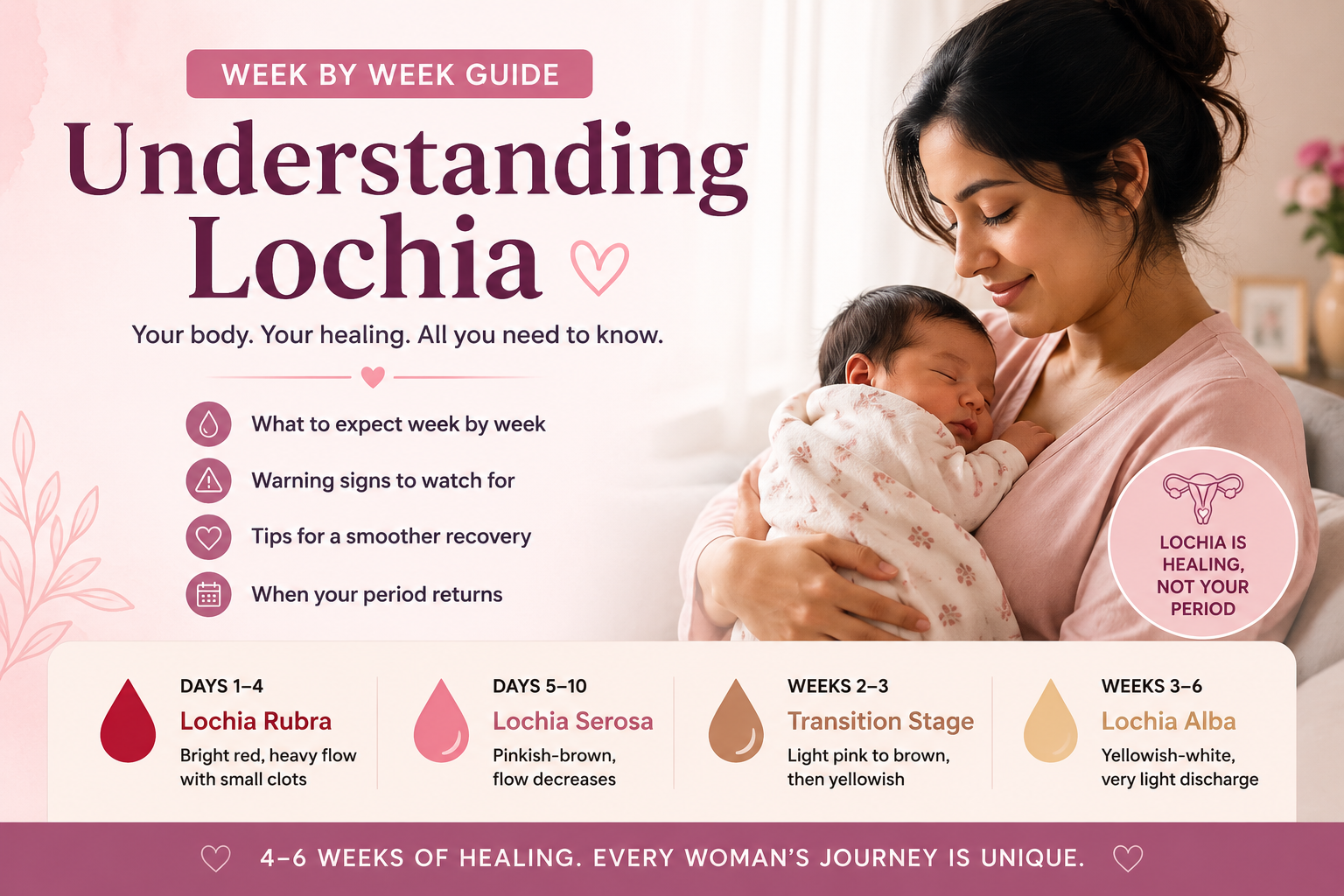
Most women bleed for 4–6 weeks after delivery. The bleeding is heaviest in the first 3–7 days, then gradually lightens in colour and amount over the following weeks. This postpartum discharge is called lochia — and it happens after both vaginal delivery and C-section. It is not a period returning. It is your uterus healing.
Here is exactly what to expect, week by week.
What is lochia?
Lochia is the vaginal discharge your body produces after childbirth. It contains blood, mucus, and the uterine tissue that lined your womb during pregnancy. As your uterus contracts and returns to its pre-pregnancy size, it sheds this lining — a completely normal and necessary part of recovery.
According to clinical guidance from the NHS and ACOG, lochia typically follows a predictable pattern across three distinct stages, though every woman's experience varies slightly. Understanding what is normal at each stage means you will know exactly when something needs a doctor's attention.
Week by week: what to expect
Days 1–4 (Lochia Rubra — bright red)
This is the heaviest stage. Lochia is bright or deep red, and the flow is similar to or heavier than a heavy period. Small clots are normal — anything up to roughly the size of a 50-rupee coin. You may need to change protection every 2–4 hours. Most women find this stage the most intense and are surprised by how heavy it can be compared to a normal period.
This is also when standard pads most often fail — the volume is higher than they are designed to handle, and lying flat at night redistributes the flow sideways, causing leaks that pads cannot prevent.
Days 5–10 (Lochia Serosa — pinkish-brown)
The colour shifts from red to pink, pinkish-brown, or watery red. The amount decreases noticeably. You are no longer soaking through protection as frequently. Some women feel relieved at this stage; others notice an increase if they have been more physically active than their body was ready for — a signal to slow down.
Weeks 2–3 (Transitioning to Lochia Alba)
Lochia becomes light pink to brown, then starts turning yellowish or cream-coloured. The amount is much lighter — closer to spotting than bleeding. Many women switch to lighter protection at this point.
Weeks 3–6 (Lochia Alba — yellowish-white)
Discharge becomes yellowish-white or creamy, very light, and may come and go rather than flowing continuously. Some women finish by week 3–4; others continue light spotting through week 6. Both are within the normal range.
By 6 weeks, most women have stopped entirely. If lochia continues heavily beyond 6 weeks, or if bleeding stops and then suddenly returns, speak to your doctor.
What can affect how long lochia lasts
Breastfeeding: Nursing releases oxytocin, the hormone that causes uterine contractions. You may notice a temporary increase in bleeding or cramping during or just after a feed. This is normal — the contractions are actually helping your uterus shrink back faster and heal more efficiently.
Physical activity: Too much activity too soon can cause lochia to temporarily increase or turn brighter red. This is your body's way of asking you to rest. If bleeding increases after you have been more active, lie down and see if it settles.
C-section delivery: You will still have lochia after a C-section — some blood is suctioned during surgery, so it may start slightly lighter, but the stages and the 4–6 week timeline are the same. The main difference is that high-waist, soft protection matters more post-C-section to avoid putting pressure near the incision area.
Individual variation: Some women bleed for 3 weeks; some bleed lightly for 8 weeks. If you are concerned at any point, your doctor is the right person to ask.
Warning signs — when to call your doctor
Most lochia is normal. These signs are not:
Soaking through a full pad in less than an hour, two hours in a row
Passing clots larger than a 50-rupee coin
Lochia suddenly becoming heavier after it had been reducing
A foul or offensive smell — this can indicate infection
Fever above 38°C (100.4°F) with heavy bleeding
Lochia continuing heavily beyond 6 weeks
Any of these means same-day contact with your doctor or midwife — do not wait and see.
If you are passing large clots along with heavy bleeding, read our detailed guide on lochia clots and when to worry, which covers exactly what size and frequency is normal versus what needs urgent attention.
When does your period return after lochia ends?
Lochia ending does not mean your period is back. They are different.
If you are not breastfeeding, your period typically returns within 6–12 weeks of delivery. If you are breastfeeding exclusively, the return can take much longer — sometimes not until you reduce feeds significantly or stop altogether, which can be anywhere from a few months to over a year. The hormone prolactin, which supports milk production, suppresses ovulation and delays menstruation.
Your first period after lochia is often heavier or different from your pre-pregnancy periods. This is normal and usually settles by the second or third cycle.
What to use for protection during lochia
Standard pads are often inadequate for the first week of lochia — the volume is higher than a period, the flow is unpredictable, and overnight leaks from the sides and back are very common because pads only protect front to back.
A disposable period panty covers all four directions and holds the equivalent of about four regular pads' worth of fluid, which makes it significantly more reliable for the lochia rubra stage and overnight. The Dreamease disposable period panty is designed specifically for postpartum recovery and heavy flow — shop the disposable period panty, or if you have questions about your recovery, book a consultation with our gynaecologist.
Many women use a disposable panty for the first one to two weeks, then transition to pads or panty liners as lochia lightens.
Questions readers ask
How long does postpartum bleeding (lochia) last?
Most women bleed for 4–6 weeks after delivery. The first 3–7 days are heaviest, then bleeding gradually lightens in colour and amount, stopping by around week 6.
What are the three stages of lochia?
Lochia rubra (days 1–4, bright red and heavy), lochia serosa (days 5–10, pinkish-brown and lighter), and lochia alba (weeks 2–6, yellowish-white and very light).
When should I be worried about postpartum bleeding?
Call your doctor if you soak a full pad in under an hour, pass clots larger than a 50-rupee coin, notice a foul smell, develop a fever, or bleeding suddenly gets heavier after reducing.
Is postpartum bleeding different after a C-section?
You will still have lochia after a C-section. It may start slightly lighter, but it follows the same three stages and the same 4–6 week timeline.
Does breastfeeding affect lochia?
Yes - breastfeeding releases oxytocin which causes uterine contractions. You may notice a temporary increase in bleeding while nursing. This is normal and helps the uterus heal.